BEGIN:VCALENDAR
PRODID:-//Microsoft Corporation//Outlook 14.0 MIMEDIR//EN
VERSION:2.0
METHOD:PUBLISH
BEGIN:VTIMEZONE
TZID:Asia/Hong_Kong
X-LIC-LOCATION:Asia/Hong_Kong
BEGIN:STANDARD
TZOFFSETFROM:+0800
TZOFFSETTO:+0800
TZNAME:HKT
DTSTART:19700101T000000
END:STANDARD
END:VTIMEZONE
BEGIN:VEVENT
UID:G16c3220i263905N714915
SEQUENCE:0
DTSTAMP:20260515T165100Z
ORGANIZER;CN=School of Creative Media:mailto:
DTSTART:20260528T000000
DTEND:20260530T000000
LOCATION:Future Cinema Studio
DESCRIPTION:Goto CAP message : https://cap.cityu.edu.hk/studentlan/postDetail.aspx?id=G16c3220i263905N714915\n\n\n \n Abstract\n Two great forces have governed the development of world cinema and our conception of it. On the one hand\, Hollywood’s pervasively influential projection of life style through film style\, and on the other\, partly in opposition and equally significant\, the predominantly European\, auteurist\, model of stylistic\, and sometime socially-engaged\, cinema\, enshrined within the promotional machinery of the film festival and the various “new wave.” In the meantime\, Indian cinema\, which emerged as a new force on the global stage with independence\, after the striking success of Raj Kapoor’s and Nargis’s Awaara (1951)\, and established itself as the world’s second largest cinema\, for many years remained largely invisible in western-centric film history\, save for a few acclaimed auteurs. This was partly because its popularity lay outside Europe and America\, and partly because the nature of its melodramatic appeal—above all through the romantic idiom of song and dance—eluded western taste-makers and audiences alike. However\, this was not the case in a large part of the world\, especially the Soviet Union\, the Middle East\, South East Asia\, and Africa\, where the aesthetics of Indian cinema spoke\, in part\, across the boundaries of language\, and sometimes\, no doubt\, as in India itself\, to unlettered audiences.\n \n Now times have changed\, and the last 20 years have witnessed a flourishing of scholarship on Indian cinema both in India and across the west\, especially on Bollywood\, which is consonant with the shift in status of the Indian film industry itself (finally made official in 1998) and its more assertive presence on the global stage\, in part through the growing disposable income and clout of non-resident Indians. Yet much remains to be understood about the global histories and trajectories of Indian cinema outside the orbit of Europe and America and\, in particular\, the transactions that have taken place between India and other Asian countries that are the focus of this conference. Perhaps because Indian cinema has occupied a position as the largest global rival to Hollywood\, it has tended to be studied independently of its relationships to other Asian cinema cultures. Yet these histories are both closely interwoven and inter-culturally specific: from the long history of co-productions with Iran and the reception of Indian cinema in the middle east\, to the way Hong Kong cinema helped catalyse the remarkable shift in Indian cinema of the 1970s towards action cinema and the recent impact of Korean cinema.\n \n Hosted by the School of Creative Media at City University of Hong Kong\, this three-day conference brings together leading and emerging scholars from the Asia-Pacific\, Europe\, and North America. We look forward to welcoming attendees to Hong Kong for a landmark event in the study of Asian cinemas.\n \n Keynote Speakers\n S.V. Srinivas\, Azim Premji University\n Tamaki Matsuoka\, Asian Film Researcher\n Krista Van Fleit\, University of South Carolina\n Rashmi Doraiswamy\, Film Critic\n \n Plenary Speakers\n Sangita Gopal\, University of Oregon\n Nitin Govil\, University of Southern California\n Dale Hudson\, NYU Abu Dhabi\n Haina Jin\, Fudan University\n Monika Mehta\, Binghamton University\n Swapnil Rai\, University of Michigan\n Iain Robert Smith\, King’s College London\n Samhita Sunya\, University of Virginia\n \n Moderators\n Bidisha Banerjee\, The Education University of Hong Kong\n Wesley Jacks\, Lingnan University\n Jia Tan\, Chinese University of Hong Kong\n Louisa Wei\, City University of Hong Kong\n Jamie Zhao\, City University of Hong Kong\n \n Conference Organizers\n Professor Richard William Allen \, City University of Hong Kong\n Professor Sangjoon Lee \, City University of Hong Kong\n \n For more details\, please visit: https://www.scm.cityu.edu.hk/events/india-in-asia \n \n Free admission. Advance registration is required.\n Registration: https://forms.gle/LWrcosf2FkPU5fuaA \n RSVP by 25 May 2026\, 5:00 pm.\n \n
X-ALT-DESC;FMTTYPE=text/html:Click here to CAP message
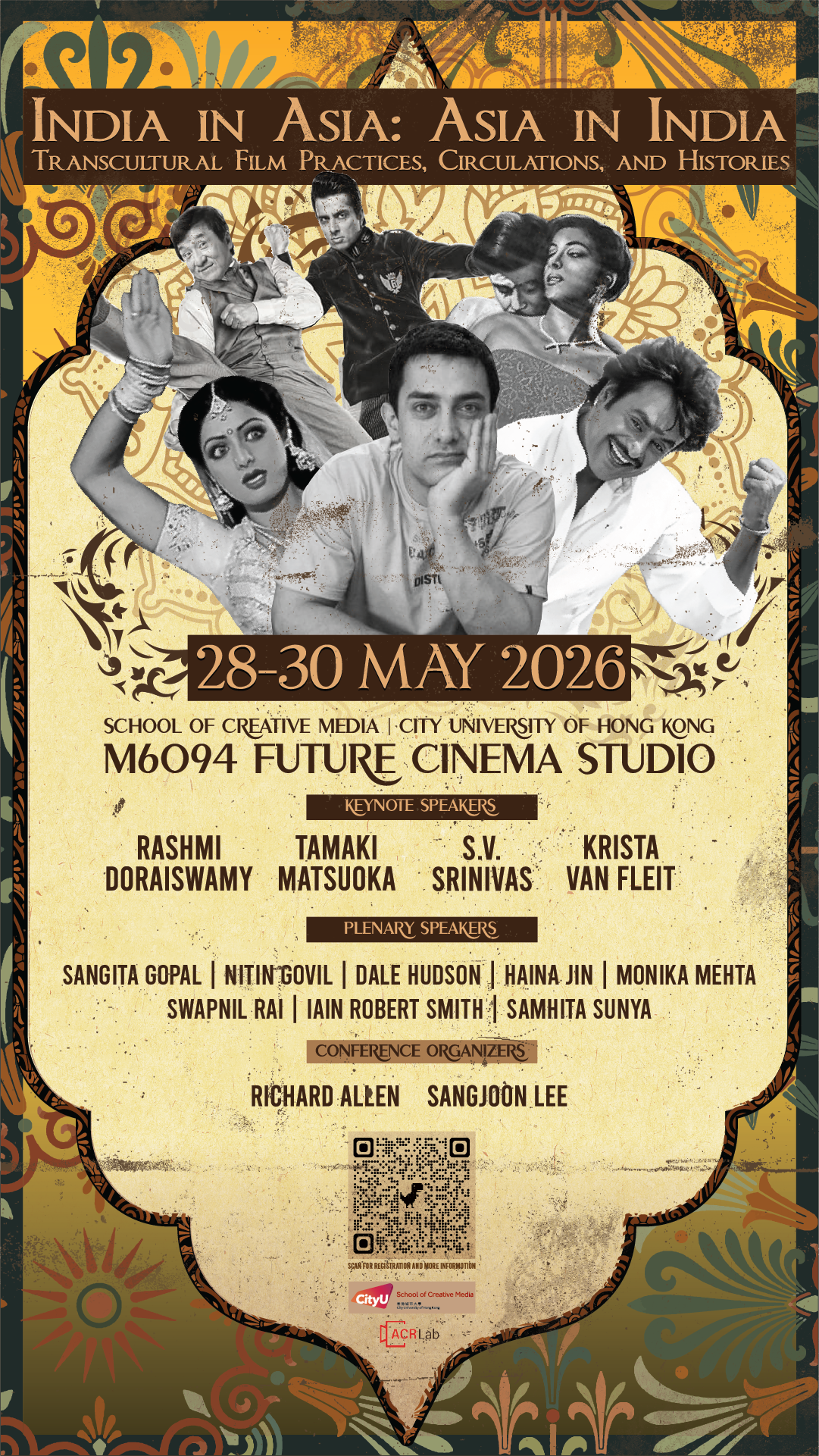
Abstract
Two great forces have governed the development of world cinema and our conception of it. On the one hand, Hollywood’s pervasively influential projection of life style through film style, and on the other, partly in opposition and equally significant, the predominantly European, auteurist, model of stylistic, and sometime socially-engaged, cinema, enshrined within the promotional machinery of the film festival and the various “new wave.” In the meantime, Indian cinema, which emerged as a new force on the global stage with independence, after the striking success of Raj Kapoor’s and Nargis’s Awaara (1951), and established itself as the world’s second largest cinema, for many years remained largely invisible in western-centric film history, save for a few acclaimed auteurs. This was partly because its popularity lay outside Europe and America, and partly because the nature of its melodramatic appeal—above all through the romantic idiom of song and dance—eluded western taste-makers and audiences alike. However, this was not the case in a large part of the world, especially the Soviet Union, the Middle East, South East Asia, and Africa, where the aesthetics of Indian cinema spoke, in part, across the boundaries of language, and sometimes, no doubt, as in India itself, to unlettered audiences.
Now times have changed, and the last 20 years have witnessed a flourishing of scholarship on Indian cinema both in India and across the west, especially on Bollywood, which is consonant with the shift in status of the Indian film industry itself (finally made official in 1998) and its more assertive presence on the global stage, in part through the growing disposable income and clout of non-resident Indians. Yet much remains to be understood about the global histories and trajectories of Indian cinema outside the orbit of Europe and America and, in particular, the transactions that have taken place between India and other Asian countries that are the focus of this conference. Perhaps because Indian cinema has occupied a position as the largest global rival to Hollywood, it has tended to be studied independently of its relationships to other Asian cinema cultures. Yet these histories are both closely interwoven and inter-culturally specific: from the long history of co-productions with Iran and the reception of Indian cinema in the middle east, to the way Hong Kong cinema helped catalyse the remarkable shift in Indian cinema of the 1970s towards action cinema and the recent impact of Korean cinema.
Hosted by the School of Creative Media at City University of Hong Kong, this three-day conference brings together leading and emerging scholars from the Asia-Pacific, Europe, and North America. We look forward to welcoming attendees to Hong Kong for a landmark event in the study of Asian cinemas.
Keynote Speakers
S.V. Srinivas, Azim Premji University
Tamaki Matsuoka, Asian Film Researcher
Krista Van Fleit, University of South Carolina
Rashmi Doraiswamy, Film Critic
Plenary Speakers
Sangita Gopal, University of Oregon
Nitin Govil, University of Southern California
Dale Hudson, NYU Abu Dhabi
Haina Jin, Fudan University
Monika Mehta, Binghamton University
Swapnil Rai, University of Michigan
Iain Robert Smith, King’s College London
Samhita Sunya, University of Virginia
Moderators
Bidisha Banerjee, The Education University of Hong Kong
Wesley Jacks, Lingnan University
Jia Tan, Chinese University of Hong Kong
Louisa Wei, City University of Hong Kong
Jamie Zhao, City University of Hong Kong
Conference Organizers
Professor Richard William Allen, City University of Hong Kong
Professor Sangjoon Lee, City University of Hong Kong
For more details, please visit: https://www.scm.cityu.edu.hk/events/india-in-asia
Free admission. Advance registration is required.
Registration: https://forms.gle/LWrcosf2FkPU5fuaA
RSVP by 25 May 2026, 5:00 pm.
SUMMARY:[Conference] India in Asia: Asia in India Transcultural Film Practices, Circulations and Histories
STATUS:CONFIRMED
END:VEVENT
END:VCALENDAR